Content Marketing for Expert Interviews: Turn Specialist Insights into Distinctive Articles
Learn how to identify the right experts, ask questions that reveal useful insights, and shape interviews into accurate, reader-focused content. Includes practical guidance for editing, approvals, and reuse.
An expert interview becomes a distinctive article when it captures how a specialist makes decisions—not merely what they know. If your interviews produce familiar advice or drafts that stall in review, change the process before changing the prose. Define a reader problem, ask for the reasoning behind specific decisions, and preserve enough evidence and context to support what you publish.
This walkthrough treats the interview as source gathering for a useful article, rather than a conversation you will polish into a transcript. The goal is to leave with an explanation readers can act on: what to notice, what to do, why it works, and when a different approach is needed.
Choose an Expert and Define the Reader’s Need
Start with the reader’s decision, not the expert’s biography. A broad assignment such as interviewing a cybersecurity leader leaves too much room for general commentary. A narrower brief—helping an operations manager decide which access permissions to review first—gives you a way to select the source, prepare questions, and judge which answers belong in the article.
Write a short editorial brief before booking the conversation. Specify who the reader is, what situation triggers their search, what they already understand, and what they should be able to decide or do afterward. Add the article’s boundaries. If the piece explains how to evaluate a process, for example, it may not need a history of the discipline or a detailed product comparison.
Reader: Identify a role and situation, rather than a broad audience such as business professionals.
Need: Name the unresolved question or obstacle that brings the reader to the article.
Outcome: Define a practical decision, diagnostic step, or action the article should support.
Scope: Record what the piece will not attempt to explain.
Evidence: Note which examples, documents, or independent sources would make the explanation credible.
Choose an expert whose experience matches that brief. Someone who performs the work may explain failure modes more precisely than someone with a senior title but little recent hands-on involvement. A researcher may be better suited to explaining a body of evidence, while a practitioner may be better suited to describing implementation constraints. Check relevant work, publications, responsibilities, and any commercial interest that could shape their recommendations.
Use a short preliminary exchange to test fit. Ask which part of the problem the person handles directly, which situations they cannot speak to, and whether they can discuss examples without breaching confidentiality. If their experience covers only one part of the article, narrow the piece or add another source rather than asking them to supply authority they do not have.
Prepare Questions That Go Beyond Familiar Talking Points
Research the basics before the interview so the expert does not spend the session defining terms you could have checked elsewhere. Review their relevant published work and the material your audience is likely to encounter. Note where existing explanations become vague: a recommendation with no decision rule, a claimed benefit with no conditions, or a process that skips the difficult step.
Build the question sequence around those gaps. Begin with the situation, move into a specific decision, then explore the evidence, alternatives, and limits. Send the expert the reader brief and main themes in advance, including any requests for documents or examples. Advance preparation is especially useful when an accurate answer depends on checking records; it does not require turning the interview into a scripted presentation.
Situation: What usually happens just before someone realizes they have this problem?
Diagnosis: Which observation helps you distinguish this issue from a similar-looking one?
Decision: Walk through a specific case you can discuss. What did you consider first, and what changed your approach?
Tradeoff: What does your recommended approach sacrifice, and when would you choose another option?
Evidence: What supports that conclusion, and which parts are based on your own experience?
Failure: Where do capable teams get this wrong, and how can they detect the mistake?
Boundary: Under what conditions would this advice stop applying?
Prepare follow-ups rather than a long inventory of unrelated questions. When the expert recommends better collaboration, ask who needs to exchange what information, at which point, and how that changes the next decision. When they say something depends on context, ask which variables matter most. The purpose is not to force a neat answer; it is to make the conditions visible.
Hypothetical example: For an article about choosing a customer onboarding process, asking for best practices may produce a familiar checklist. Asking how the process should change when users need administrator approval can reveal dependencies, delays, and alternative paths that make the article more useful.
Record Useful Answers and Capture Supporting Details
Before recording, explain how the conversation will be used and obtain consent consistent with applicable requirements and your organization’s policy. Clarify attribution, confidentiality, and the agreed review process. Do not assume that permission to speak includes permission to publish client names, internal metrics, screenshots, or sensitive operational details.
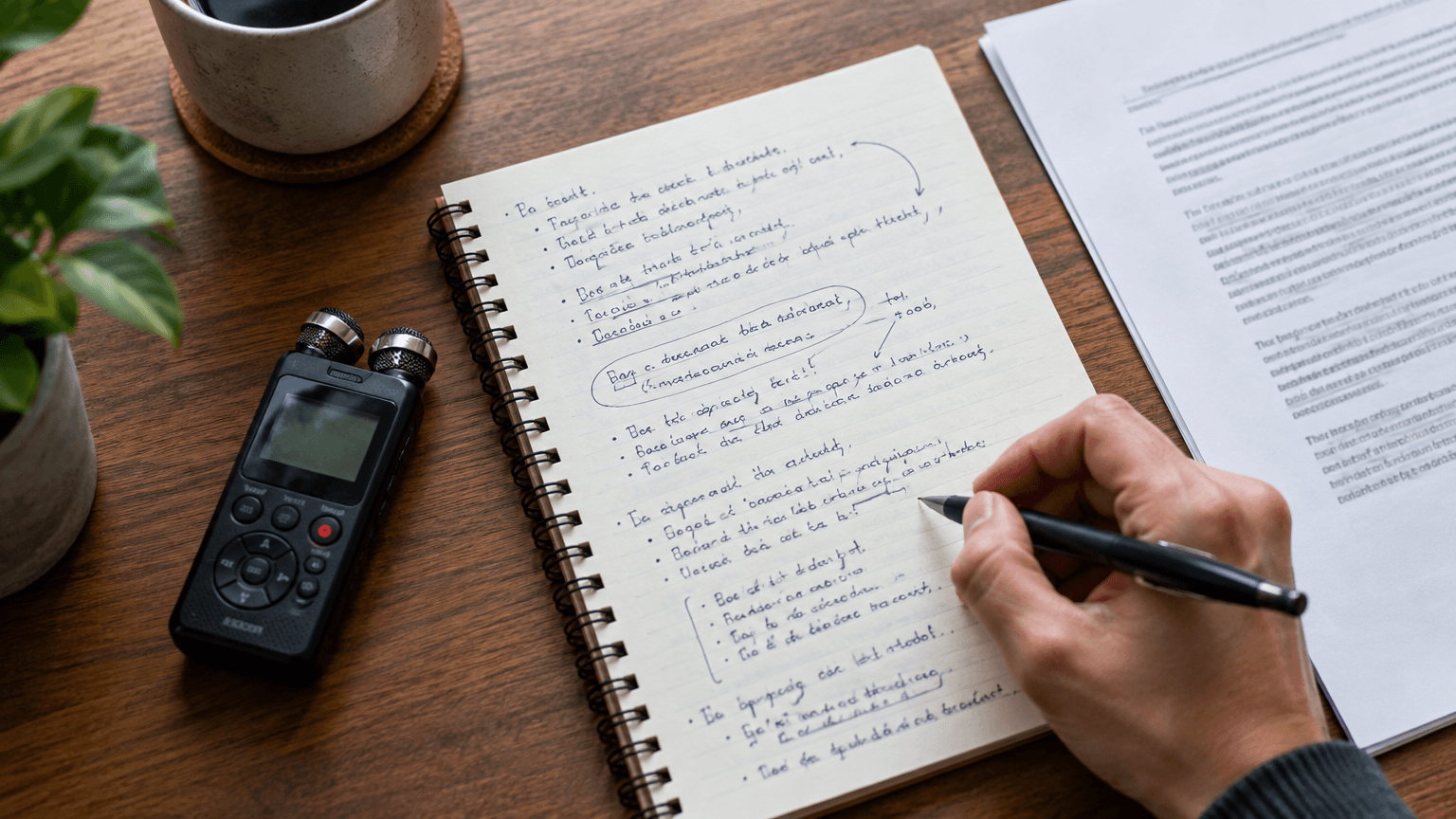
Use a recording, where permitted, to preserve wording, but keep selective notes for editorial navigation. Mark timestamps for strong explanations, unfamiliar terms, claims needing verification, and promised follow-up material. If you use transcription software, check its privacy and data-handling arrangements before uploading sensitive material. A transcript is a working aid, not an authoritative record of every word.
Capture the Reasoning Behind the Answer
Listen for the chain connecting observation to action. An answer becomes useful when it identifies the starting conditions, the signal the expert noticed, the options available, the choice made, and its limitations. If one link is missing, ask for it while the context is fresh. Avoid racing to the next prepared question simply because the expert has stopped speaking.
Separate a real example from a hypothetical illustration as soon as it appears. For a real case, establish what the expert personally observed, what they learned from others, and what can be disclosed. For a hypothetical scenario, record the assumptions and label it accordingly in the article. Never turn an illustrative possibility into a customer story.
For a number, capture its source, timeframe, unit, comparison, and relevant sample or denominator.
For an outcome, ask what changed and whether other factors could explain the change.
For a process, capture prerequisites, sequence, ownership, and exceptions.
For a technical term, ask for a plain-language explanation and any distinction that must survive editing.
For a supporting document, confirm whether you may review it, cite it publicly, or use it only as background.
Close by summarizing the central explanation in your own words and asking whether you have missed a qualification. Confirm outstanding evidence, permissions, and follow-up responsibilities. This catches misunderstandings early without treating the expert’s agreement as a substitute for later fact-checking.
Edit for Clarity While Preserving the Expert’s Meaning
Do not begin by cleaning up the transcript line by line. First, extract the material into an evidence outline organized around the reader’s problem. Group related explanations even when they occurred far apart in the conversation. For each planned section, identify the reader question, the expert’s contribution, the supporting material, and any unresolved gap.
Build the article around a clear line of reasoning rather than the order of the interview. A practical structure might explain how to recognize the problem, choose an approach, carry it out, and check whether it is appropriate. Remove biographical detours unless they help readers assess the expert’s relevant experience or potential conflicts.
Separate Explanation, Attribution, and Evidence
Use your own prose to provide transitions and explain established context. Attribute judgments, interpretations, and experience-based recommendations to the expert where that distinction matters. Support externally verifiable claims with suitable sources. Attribution tells readers who made a claim; it does not establish that the claim is correct.
If the article uses direct quotations, check them against the recording or another reliable original record. Do not assemble fragments into a sentence the expert never said or polish a hesitant answer into a stronger assertion. When the original wording is awkward, paraphrase accurately and retain the relevant attribution instead of presenting rewritten language as a quotation.
Preserve conditions and uncertainty during simplification. A recommendation that applies to a particular workflow should not become a universal rule. An observed association should not become a causal claim. Replace jargon when possible, but keep technical distinctions that affect what the reader should do. If you cannot explain a distinction confidently, flag it for clarification rather than smoothing it away.
When a section feels generic, diagnose the missing material before rewriting it. A missing example needs follow-up reporting; a missing decision rule needs a more precise question; a missing source needs verification. Stronger adjectives cannot repair weak evidence.
Verify Claims, Secure Approvals, and Plan Publication
Run a separate verification pass after the structure is stable. Check names, roles, technical descriptions, numbers, chronology, and the scope of recommendations. For research-based claims, inspect the underlying source where available rather than relying on a summary. Confirm that the source actually supports the sentence you have written, including its population, conditions, and limitations.
Keep a simple claim log with the draft passage, supporting source, verification status, and person responsible for resolving questions. Distinguish independently supported facts from the expert’s interpretation and firsthand account. If a material claim cannot be substantiated, narrow it, clearly qualify its basis, or remove it. Confidential evidence may inform reporting, but readers should not be led to believe they can inspect evidence that is unavailable to them.
Make Review Requests Specific
An open-ended request to approve a draft can trigger a full rewrite or leave everyone unsure what approval means. Agree on review scope before the interview, then send a focused request. Ask the expert to check technical accuracy, faithful representation, attribution, and sensitive details. State the deadline and identify unresolved questions directly. Follow any previously agreed contractual or organizational approval requirements.
Expert review: Check meaning, technical qualifications, and descriptions of firsthand experience.
Editorial review: Check usefulness, structure, clarity, sourcing, and consistency with the reader brief.
Permissions review: Confirm authorization for names, documents, visuals, and confidential or third-party information.
Specialist review where needed: Route high-stakes legal, medical, financial, or other regulated material through the appropriate review process.
Resolve substantive changes against the evidence rather than accepting them automatically. A reviewer may introduce a new number, expand a claim, or remove an important caveat. Those edits require fresh checks. Keep version history and a record of decisions, and do not treat silence as approval when explicit approval is required. If a necessary review remains incomplete, delay publication or remove the affected material.
Publish Around the Reader’s Task
For search presentation, make the title and description reflect the problem the article actually solves. Use descriptive headings, explain unfamiliar terms where readers encounter them, and link to relevant supporting sources and useful related pages. Identify the expert’s relevant credentials and disclose material relationships where appropriate. Do not stretch a narrow interview into a broad definitive guide merely to target a larger keyword.
Assign responsibility for post-publication corrections and review when the subject warrants it. Time-sensitive claims, changing product behavior, and evolving guidance need different maintenance from an article about a stable reasoning process. Any excerpts reused in newsletters or social posts should retain the qualifications needed to avoid changing their meaning.
For your next interview, start with a one-page brief naming the reader’s decision, the expert’s relevant experience, and three gaps the conversation must resolve. Then prepare a follow-up question for each gap and agree on review responsibilities before recording. That gives you a practical foundation for an article built on specific reasoning rather than generic quotes.