Social Media Comment Moderation: Build a Response System Without Losing Your Brand Voice
A surge of comments can quickly overwhelm a social team, especially when criticism, spam, and genuine questions land together. Learn how to triage responses, set escalation rules, and keep replies consistent without sounding scripted.
A busy comment queue needs more than fast replies. It needs a way to distinguish a routine question from an unresolved complaint, a credible threat, or criticism that should remain visible. Build your social media comment moderation system around two separate decisions: what action the comment requires and how your brand should sound when taking it. This lets moderators move quickly without treating every person like a support ticket.
Start with one shared queue or tracking view, a short classification scheme, named owners, and an escalation route that works during your actual coverage hours. The walkthrough below turns those pieces into a repeatable workflow. Use the examples as drafting patterns, not approved statements about your own products or policies.
Classify Comments by Intent and Risk
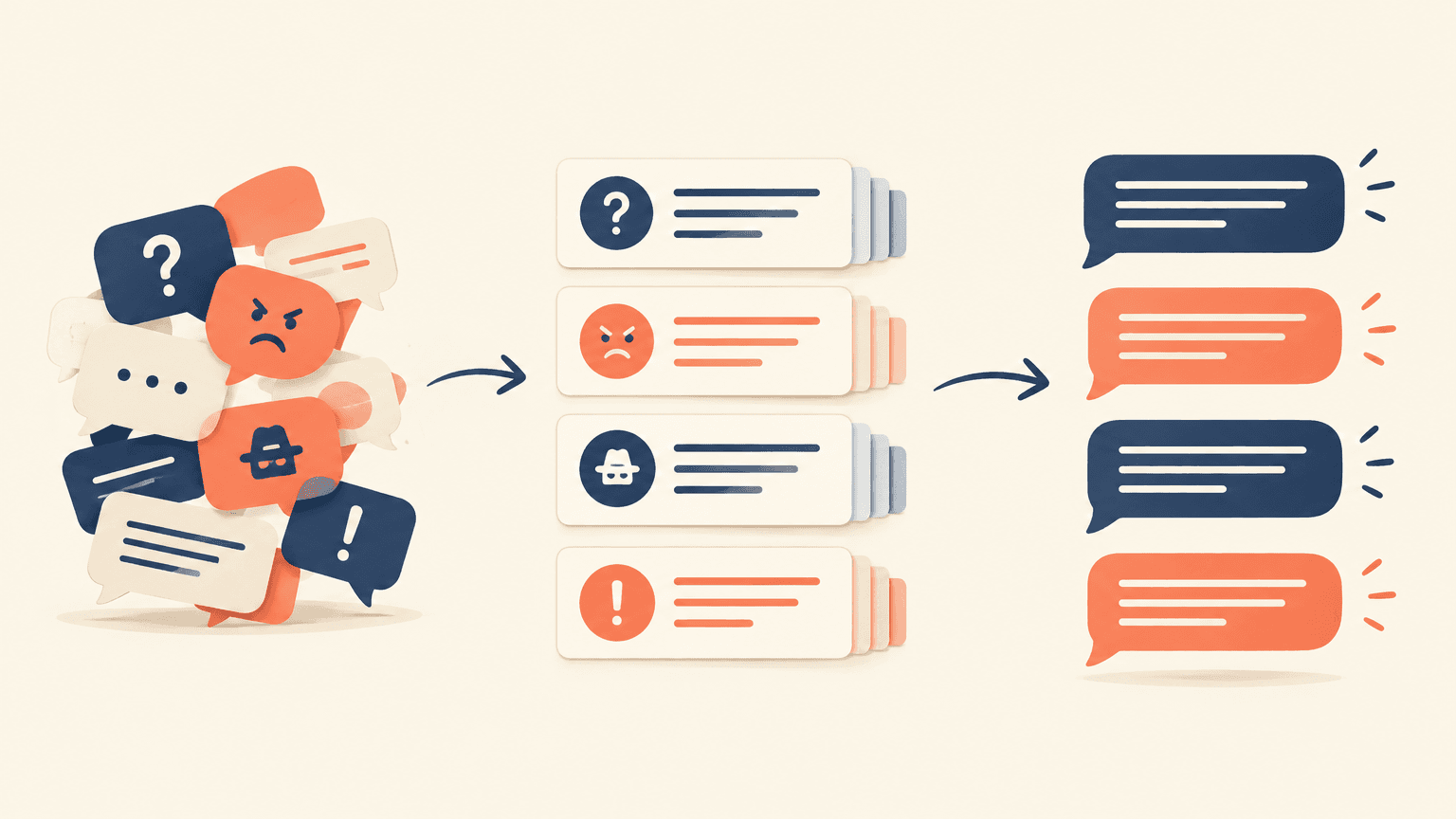
Classify comments before writing replies. Intent tells you what the person appears to need; risk tells you how carefully and urgently to handle it. Keep those labels separate. A politely worded report of an injury can carry more risk than an angry complaint about shipping, and profanity alone does not make a comment a threat.
Use a small set of intent labels
Information request: A question about availability, pricing, instructions, access, or policy. Answer from an approved source or route it to someone who can verify the answer.
Service complaint: A problem with an order, account, appointment, or experience. Acknowledge the issue and identify the support route.
Feedback or disagreement: An opinion about the brand, its content, or its decisions. Decide whether a useful response is possible; disagreement does not automatically require removal.
Praise or community participation: Appreciation, relevant conversation, or a contribution worth acknowledging. Use selective replies rather than filling the thread with repetitive thank-you messages.
Spam, impersonation, or manipulation: Unrelated promotions, suspicious links, fake support accounts, or repetitive attempts to redirect users. Apply the relevant moderation rule and report where appropriate.
Abuse, safety concern, or sensitive disclosure: Harassment, threats, exposed personal information, or reports involving potential harm. Route these for risk assessment rather than leaving them in the routine reply queue.
Add a risk label such as routine, elevated, or urgent. Routine comments can follow approved guidance. Elevated comments need verification, specialist input, or a second reviewer. Urgent comments involve a plausible immediate safety concern, active exposure of sensitive information, or another issue covered by your incident plan. When context is unclear, flag uncertainty rather than forcing a confident classification.
Separate the reply decision from the visibility decision
A comment may need a response without needing removal. It may also need removal without a public reply. Create explicit criteria for leaving, replying, hiding, deleting, reporting, and restricting accounts. Platform controls differ, so document what each action does on each channel instead of assuming that hiding has the same effect everywhere.
Moderate conduct, not sentiment. Negative feedback should not disappear merely because it is uncomfortable. Apply published community rules consistently, preserve relevant evidence when safe, and explain moderation decisions when doing so would help rather than amplify harm.
For a hypothetical example, a customer might report a missing delivery and include their home address. The complaint deserves a support response; the exposed address needs a separate privacy action. Record only the information necessary for follow-up, restrict access, and use the platform’s available controls to reduce exposure. Do not repeat the address in your reply.
Set Response Times and Ownership Rules
Set response targets around staffing and risk, not an expectation that every comment deserves an immediate answer. Define when your team monitors each channel, what happens outside those hours, and which incidents can reach an on-call owner. Do not publish a response promise that your rota cannot support.
Urgent risk: Alert the designated incident owner as soon as the comment is identified. Use an acknowledged handoff rather than assuming a notification was seen.
Elevated complaint or sensitive allegation: Prioritize assessment during the active shift. Send a verified acknowledgment when appropriate, without guessing at the outcome.
Routine question or support request: Handle within a defined service window, with older unanswered items visible to the next shift.
Praise, general discussion, and low-value repetition: Review after higher-priority needs. A reaction, selective reply, or no response may be appropriate.
Define three different clocks: time to triage, time to first useful response, and time to resolution or the next update. A quick acknowledgment is not a resolved case. Track delays waiting for internal teams separately so that pressure to improve response speed does not encourage empty replies or premature closure.
Give every open item one accountable owner
The moderator who spots a problem may not be the person who solves it, but someone must remain responsible for the handoff. Assign a queue owner, a subject-matter owner, and a backup where needed. The queue owner keeps the public thread and case status current; the specialist verifies facts or handles the underlying issue.
Keep a minimal record for each actionable item: comment link, channel, intent, risk, assigned owner, current status, next action, and update deadline. Useful statuses include new, assigned, waiting for customer, waiting internally, and closed. Avoid copying sensitive customer information into broadly accessible spreadsheets or chat channels.
At shift change, hand over unresolved high-risk items explicitly. Include what has been confirmed, what has already been said publicly, who is working on the issue, and when the next update is due. During volume spikes, prioritize safety, sensitive disclosures, and actionable service issues before discretionary engagement. If automation helps sort or route comments, keep a manual path for mistakes and exceptions.
Write Voice Guidelines for Common Situations
Brand voice should remain recognizable, but tone must respond to the situation. A playful brand can still be plain and serious when someone reports harm. Define a few stable traits, such as direct, warm, and practical, then describe how each trait changes under pressure. Warmth might mean enthusiasm in a praise thread and patient acknowledgment in a complaint.
Translate traits into observable writing rules. Direct means answering the actual question before adding context. Warm means recognizing a specific concern rather than inserting generic sympathy. Practical means offering one clear next step. Also state boundaries: no sarcasm during disputes, no jokes about safety concerns, no defensive speculation, and no promises that depend on another team’s unconfirmed actions.
Build response patterns, not identical scripts
A useful response library stores the purpose of a reply, required facts, adaptable wording, and conditions that require escalation. Give each entry an owner and review date. Keep verified policy details separate from tone guidance so moderators do not accidentally reuse an outdated refund rule or service instruction.
Routine question: Lead with the verified answer, add any important limitation, and provide the relevant next step. Do not send someone to a general help page when you can answer the question accurately in the thread.
Service complaint: Acknowledge the specific problem, explain what can happen next, and move account-specific details to an approved private route.
Critical feedback: Address the substantive point if you have useful information. Avoid arguing about the commenter’s attitude or trying to win the exchange.
Praise: Refer to what the person appreciated. Vary replies naturally and avoid turning every acknowledgment into a sales pitch.
Unverified allegation: Recognize that the report needs review without presenting the allegation as established fact or dismissing it without investigation.
Rule violation: State the relevant boundary briefly when a response is useful. Do not mirror insults or invite a prolonged debate about enforcement.
Hypothetical drafting example for a delivery complaint: acknowledge that the delivery has not arrived, ask the person to use the approved support channel, and explain which reference the support team needs there. Keep that reference out of the public thread. The structure preserves a helpful voice without pretending the moderator has already checked tracking or can guarantee a replacement.
Before publishing, check four things: Did we address this person’s actual comment? Are the facts verified? Does the tone match the stakes? Is the next step clear and safe? If any answer is no, revise or escalate rather than polishing the wording.
Escalate Threats, Complaints, and Sensitive Issues
Escalation should be triggered by defined conditions, not by how uncomfortable a moderator feels or how many followers a commenter has. Reach can affect communications planning, but a low-visibility report can still involve serious harm. Give moderators clear authority to stop routine engagement and contact the appropriate owner.
Threats or apparent immediate danger: Follow the safety incident procedure and notify the designated security or emergency contact. Where there appears to be imminent danger, use the appropriate local emergency route and platform reporting tools; do not rely on a public reply alone.
Self-harm or acute distress: Use the platform’s relevant safety reporting options and the organization’s approved response guidance. Do not attempt a public diagnosis or position the brand as a crisis counseling service.
Personal information or suspected account compromise: Route to privacy or security owners. Limit further disclosure and direct the person to an approved secure channel.
Injury, product safety, discrimination, or other serious allegations: Notify the relevant specialist and communications owner. Avoid determining fault or making factual claims before review.
Unresolved or repeated service failures: Escalate to a support lead when the ordinary route has failed, the same issue recurs, or a promised update has been missed.
Rapidly spreading disputed claims: Verify facts with the responsible team and coordinate a consistent response. Do not repeat a harmful claim unnecessarily just to rebut it.
Use a compact escalation packet
Send the receiving owner enough context to act: the original link, a concise summary, relevant timestamps, the suspected risk, any action already taken, and the decision needed. Preserve evidence according to your organization’s access and retention rules, without circulating sensitive material more widely than necessary. Distinguish confirmed facts from the commenter’s claims and the moderator’s interpretation.
Require acknowledgment from the receiving owner and specify a fallback contact if they do not respond within the incident window. A tag in a chat room is not a completed escalation. The queue owner should know whether to pause replies, publish an approved holding response, or continue handling unrelated comments.
For complaints moved into private support, retain responsibility for the public loose end. Where appropriate, return with a brief update that does not disclose case details or imply resolution the customer has not confirmed. Moving a conversation out of public view is a privacy measure, not a substitute for follow-through.
Review Moderation Results and Refine the Workflow
Review whether the system makes sound decisions, not just whether it clears the queue. Combine operational measures with a sample of actual conversations. A fast response can still be inaccurate, dismissive, or unsafe; a low removal count can reflect either healthy discussion or missed abuse.
Queue health: Track incoming volume, backlog age, and unresolved items by priority and channel. Separate actionable comments from those that need no reply.
Timeliness: Review triage time, first useful response time, overdue updates, and escalation acknowledgment. Compare results within staffed hours as well as overall elapsed time.
Decision quality: Sample replies for factual accuracy, relevance, privacy handling, tone, and a clear next step.
Moderation consistency: Review removals, restrictions, reports, and reversed decisions against the same community rules.
Handoff quality: Check for unaccepted escalations, duplicate replies, missing context, and cases closed without a clear outcome.
Recurring friction: Group repeated questions and complaints to identify unclear posts, missing help content, or issues that need attention outside the social team.
Use a regular calibration session to review ambiguous examples together. Ask moderators to classify the same comments independently, then discuss where they disagreed. If a decision depends on unwritten knowledge, update the guidance. Include samples of comments left untouched, not only replies and removals, so missed risks and unnecessary engagement are visible.
Change one part of the workflow at a time where practical. If routine questions are aging, improve answer access or staffing before demanding shorter replies. If voice is becoming mechanical, revise response patterns and coaching. If sensitive cases stall, fix ownership and fallback contacts. Give moderators a way to flag confusing rules and rotate away from sustained exposure to abusive material.
Start by applying this workflow to one active channel. Label a representative batch of recent comments, assign owners for each risk category, and draft response patterns for the situations you encounter most often. Run a handoff exercise with a hypothetical sensitive case before expanding. The immediate goal is a system your team can use consistently: clear decisions, safe escalation, and replies that still sound like your brand.